I have been busy with kids on summer break from school so any opportunity for a game has been snatched up. When the weather finally started to behave like summer there was only one thing to do!
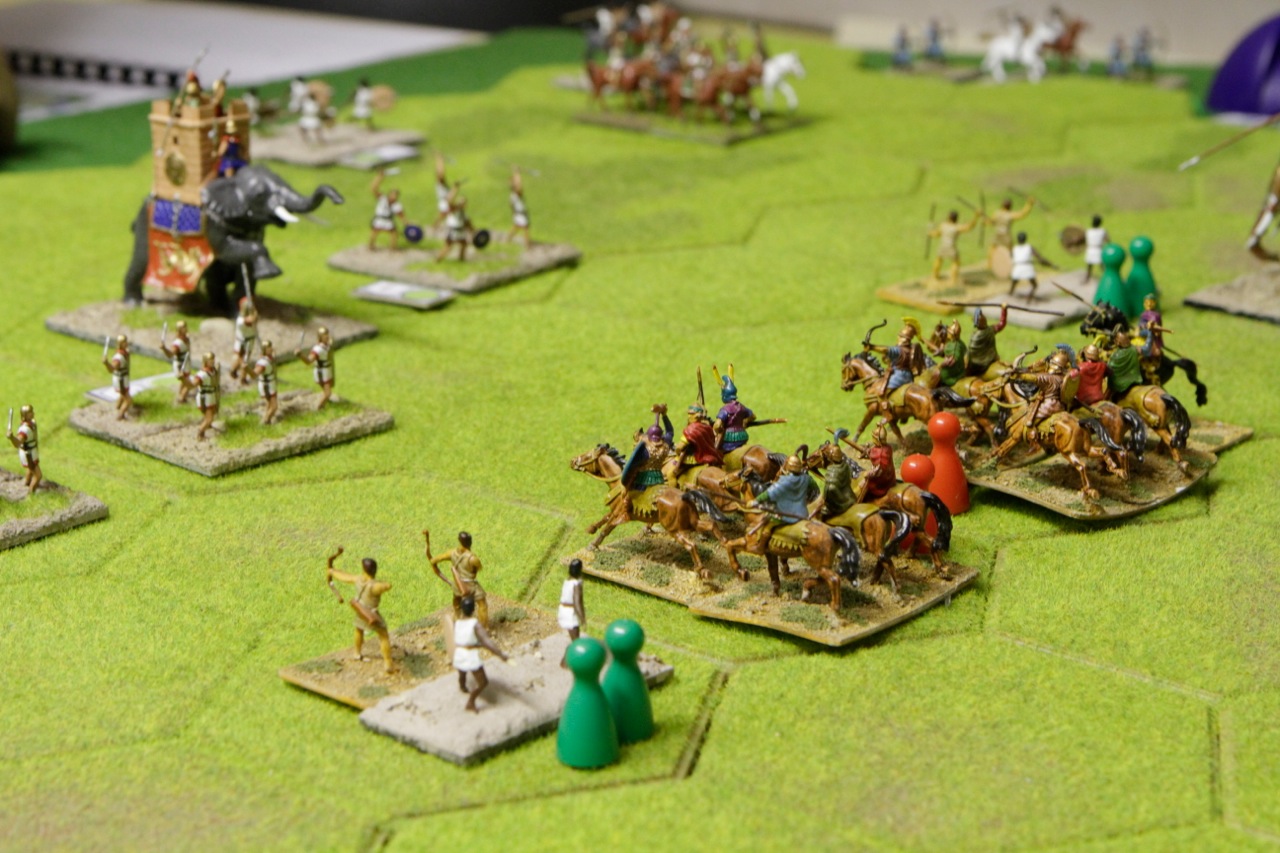
The "Hail Caesar" rulebook had eventually arrived in the post so we played a scenario from the book. "With your shield, or on it" a small hoplite battle from the Peloponnesian War. Athenians and Thebans try to block the passage of a Spartan and Corinthian force.
By the usual scale of "Hail Caesar" this is a small game with only a few units. Great for learning the system and we managed to fit three plays into the afternoon. These photos are from the first of those clashes.
I commanded the Spartan led forces against the Athenian/Theban allies commanded by Glynn.
Foreground shows Spartans and Corinthians (Spartans on right). The allies in position along the road.
There is another allied unit "hidden" in the sunken road through the forest, undeployed at start.
Confident (perhaps arrogant) in their ability to defeat any enemy, the Spartans advance. The hidden Athenian unit breaks cover to join their allies left flank.
The scenario did feature a few skirmishing units but as the phalanxes marched straight towards each other, these lighter units quickly decided to get out of harms way, unvalorous but probably wise!
Unsuprisingly the Spartans and Athenians are first to test their mettle in the othismos.
Over the next few minutes the rest of the phalanxes engaged, lots of pushing and shoving with no real advantage to either side. Eventually the quality of the Spartan units showed and a gap appeared in the allied line.
Bloody slaughter ensued !!!
The Athenians mostly fled leaving the brave Thebans to be surrounded and cut to pieces although they took a heavy toll on the Corinthians. A mighty victory for the Lacedaemonians.
In both refights the Spartans also won but the results always hung in the balance until one or two allied units broke and their line collapsed.
The rules gave a fun and fast game although the table was a bit too big for a small battle with 20mm figures. I had scaled all the rules distances to two thirds of those given.
I had just finished the Spartan Hoplites by Zvelda and this was their battle debut. Very nice figs and I think a Spartan army could be in the works.
More "Hail Caesar" battles will be played and will probably be bigger than this one.
Hi
I have evenually got around to creating a blog!
The main topic will be Wargaming.
That includes all kinds of conflict based games such as miniatures based and boardgames. Historical, fantasy and
science fiction may all make an appearance.
Sometimes the "real world" may interfere with this blog and cause non-gaming related posts. Apologies in advance.
DISCLAIMER:- This blog is a work of fiction. The people, places and products depicted are imaginary and bear no resemblance to real people, places or products either living or dead.
Showing posts with label Ancients. Show all posts
Thursday, 23 August 2012
Tuesday, 26 June 2012
Lost Battles Gaugamela Arbela 331BC
Having finished painting and dipping a huge number of 20mm plastic figures I was keen to play a battle with larger forces.
Gaugamela or Arbela seemed to fit the bill so I grabbed a few books and settled down to some light research. As usual for for the time period, details vary from source to source and numbers range from educated estimates to wild and fantastic guesswork. One thing that quickly became apparent was that the Persian infantry (which may have been present in impressive numbers) played an insignificant role in the actual battle. A lack of quality and poor positioning seems to have been involved.
In fact the "Lost Battles" book has limited the Persians to 4 infantry units in its Gaugamela scenario.
Not a problem, the core rules in Lost Battles are robust enough to allow and encourage the "What if" experiments. Adding 48,000 persian "Levy" to the battle without significantly changing the course of history turned out to be rather simple.
The plains of Gaugamela with Alexander on the left.
If you are easily offended by amateur butchery on your favourite rules, Look away now!
As the number of Persian units had increased by 50% and gone far above the normal limit (roughly 20 units for an army) I increased the -1 morale modifier for 4 units shattered to -1 for 6 units.
Attack limit increased from 5 to 6.
With the extra troops being classed as "Levy" the increase to the Persian Fighting value (and therefore their command ability) was insignificant and certainly was not going to make this mass of infantry an easy part of the army to utilise. In the end I left the FV of both armies as per the book.This actually produced just the effect I wanted.
Last of all I needed an opponent to command the Macedonians, yet again the eldest sprog strapped on the "Sandals of Command" (magic item +50% luck, +300% wisdom, gains "Big head" and "Consume Cider").
We used turn 1 for deployment and with both of us checking the historical setup we ended up as in the above photo. Alexander initially showed more caution than usual but it was part of a cunning plan.
Darius advanced cavalry on both flanks and his right centre. Then the Macedonians advanced all along the line and used Alexanders "Turn reversal" to attack.
The initial clash. Alexander can be seen urging his "companions" to the attack.
On the Persian right, Macedonian cavalry and infantry pressed forward. The Persian cavalry absorbed the charge with only 2 units damaged but their return attacks had no effect.
Persian Right. Green counters mark "levy", red counters mark "spent"
View of Macedonian centre and left.
Alexander led the charge on Darius left rear and smashed into the Persian line. In the next turn the Persian cavalry scored only 1 hit but Alexander decided to "Rally" it. Of course the dice came up double ones !!! Alexander was speared through the thigh and unhorsed, dragged from the field by his companions, he would play no further part in this battle.
Alexander the" not so" Great
For a few moments it looked like the Persians had gained the upper hand. None of the Macedonian attacks had been particularly devastating and on Darius left flank the Perian cavalry was opposed by a single light infantry unit.
Macedon right just after Alexander falls.
As news of Alexanders fall spread along the line the Macedonians surged forward thirsting for revenge. The Persian army was savaged everywhere it stood to fight.
Persian right about to collapse.
Persian centre under pressure.
Persian left, not even the threat of cavalry on the flank can slow the Macedon advance.
The Persians held on for another turn but their attacks failed to shatter any Macedonian units.
In the Macedonian turn the army of Darius started to fall apart.
Persian rout.
Darius had no intention of hanging around to face the Macedonian fury. Leaving orders for his remaining cavalry to fight to the end, the Persian King whipped several teams of chariot horses to death in a cowardly flight. Even though some Persian noble cavalry remained on the left flank we called the battle and ended here.
Persian infantry follow their Kings example.
The pursuit and slaughter lasted well into the night as surgeons and magi worked to save Alexander.
Result by Handicap points. With a massive points boost for Alexander the persians had just enough points for a very minor victory. However even with Alexander being laid low, this did not feel like a Persian victory. Only 2 Macedonian units shattered a light cavalry and a light infantry. I think the Persian army running so quickly helped deny the Macedonians points.
Result by Battle, total victory for Alexander ! He may even recover use of his leg.
With the morale modifiers for levy troops and a timid commander it was a race to see which would break first. Darius never seemed to have enough "commands" while the Macedonians could spare plenty for combat bonuses. The Persian infantry did not take an offensive role and although they did absorb some damage and deal out a couple of hits, their presence was never a real threat to Alexander.
Overall the battle was just what I wanted it to be, most importantly Fun but also Fast to play and had a Historical feel.
http://groups.yahoo.com/group/lostbattles/
There has been a long running discussion on the Lost Battles Yahoo site about the levels of leader mortality. I have never been concerned with the rule "as written" and am more than happy to see commanders bite the dust. I am playing primarily for fun with the history being a great bonus.
However there is another question, is it wise to risk your leader on a rally test. In this case absolutely not! It was the first hit on a unit in the area and had no chance of causing a morale test.
BUT ! What would Alexander have done?
My personal opinion is that Alexander would have been right in the middle of this. I don't think he was the type to see his men in trouble and not ride in.
In Glynns shoes I would do exactly the same thing,
"Death or Glory"
perhaps even both.
Labels:
Ancients,
Lost Battles
Thursday, 12 January 2012
Charonea 338BC Lost Battles
Phillip II of Macedon (With his son Alexander) must consolidate the greek nation before he turns East and invades the Persian Empire. Athens and Thebes have raised a force against him.
The Macedonians army numbered 30,000 Infantry and 2,000 Cavalry (approx)
Opposing Greek forces may have been 35,000.
For this refight, I commanded the Macedonians. My eighteen year old, Glynn, stepped up as Greek leader.
A note RE figure unit strength.
"Lost Battles" is a flexible rule system with regards to miniatures use. Most units on both sides in this battle are "Average" quality. Hoptlite and Phalanx units should have had the same number of figures/bases per unit. While setting the game up, I realised that I was only able to provide 2 bases per hoptlite unit. Rather than cut the phalanx units (4 bases) to half size, I simply played with the figures available.
This made little or no difference in play but, for the photographs, hoptlite forces should be twice their size (or phalanx units half the size. Take your pick.
This photo shows the initial positions. From top left, the "River Cephillus" flows past "Mt Akontion" and into a marsh. From the center left the river becomes a stream, the "Haemon", and flows across the battlefield to the right. The waters are "muddied" by recent rains and the activity of the armies ;-)
Macedon is deployed to the left, greeks on the right.
At the top Alexander and his cavalry watch the greek cavalry across the marsh.
On the left, the phalanx has crossed the stream to face the the hoptlites.
Slightly advanced, King Phillip, his hypaspists and "heavy " infantry (represented here by Thracian figures), are opposed by light infantry and just behind them, more hoptlites (just out of sight of the camera).
In the foreground, Mt Charonea soon to be the scene of vicious combat between light infantry of both armies.
"Macedon ready to advance"
The first "turn" of the game is taken up with deployment so we start with Turn 2.
The greeks move first and Glynn orders the cavalry to turn and watch the marsh for Alexanders advance. The greek center and center/right hoptlites advance. Light infantry race up to the high ground at Chaerona. Only the troops opposite Phillip refuse to move.
The Macedonian response is fairly predictable. Alexander turns his cavalry towards the marsh. The phalanx advances to meet the hoptlites. Phillip detaches light infantry and a unit of heavies to support the attack on Chaeronea. At this stage, I planned to attack with Alexander on the left. Push the greek skirmishers off Chaeronea and use the phalanx to hold the hoptlite line while Phillip and his veterans attack it from the side.
Glynn had other ideas!
" Greek light infantry prepare to defend Chaeronea"
Glynn choose to start his turn with an attack by his right/center hoptlites on the phalanx.
With an attack limit of 4 attacks, I was sure the phalangites could weather the storm.
WRONG.... With a flurry of incredible dice rolls (including a double six) the hoptlites smashed six hits into the stunned macedonians. This "Spent" four units and "Shattered" the fifth. Costing the greeks three "All Out" attacks and passing a morale roll was the only good news for King Phillip.
Oh well, maybe my center phalanx could perform better.
"This was not in the plan!"
Next up, Glynn attacked the center zone.... With a flurry of incredible dice rolls (including a double six) the hoptlites smashed six hits into the stunned macedonians. (Wait a minute.... have I not typed this already? Yes but he did it twice, jammy beggar!)
" Aww, C'mon"
This time it only cost the greeks two "all-out attacks" to shatter one unit and reduce the other four to "spent" status. Again the morale dice was kind to the phalanx.
Thankfully the greek cavalry attacks on Alexander were ineffective and having used all his commands for the turn, Glynn passed the dice over.
Needing to close the gap and administer some damage, I started the turn with Alexander and the cavalry. With two units of veterans I was sure to overwhelm the greek cavalry and turn their right flank. Three terrible attack rolls and total failure ensued. Zero damage.
A very "Timid" charge by Alexander.
Struggling to conceal the sudden onset of a facial tic, I turned attention to the badly beaten phalanx.
I thought a retreat might just buy enough time for some positive action elsewhere, also, should the greeks advance into the vacant zones, King Phillip would be on the end of their line.
On the Macedon right came the first glimmer of hope! Two units of light troops destroyed the greek defenders and captured Chaeronea.
"Macedon captures the high ground"
The remainder of macedons commands were used to move single units in an effort to reinforce the phalanx.
Glynn reset the command and turn tracker then grabbed the dice with a wicked grin.
Then I realised what he was so happy about. Retreating the phalanx had left his rightmost hoptlites in a position to attack Alexander from the side.
The greek cavalry attacked first and scored two hits. The hoptlites turned and smashed into the macedonians. In the slaughter that followed, Glynn rolled another double six! Alexander "Rallied" hit after hit (four rallies in total) and managed to hold on with all units spent.
" It's a Trap!"
In the center, the Greek units advanced after the phalanx.
A solitary unit of greek skirmishers took position below Chaeronea.
But time for Macedons response. I started with another mistake. It costs two action points for cavalry to move into a tile containing a marsh but normal cost to move out. Forgetting this I thought Alexander had no choice but to fight when retreat may have been wiser. At the very least his attacks this turn scored two hits reducing both greek cavalry units to spent status.
The position in the macedon rear tile looked promising. Four phalanx, two veteran and an average heavy unit backed up with all Phillips exemptions! (Not forgetting Attack limit 4) I scored a total of one hit. All the hoptlites were "spent" but no morale test needed. (My facial tic was now in spasm). Even the light infantry on Chaeronea had no success this turn. Thinking that "at least it can't get worse" I passed the turn over to Glynn.
With the Macedonian army in tatters, I expected to fail the first morale test. I was not prepared for the manner in which it happened.
The first and final attack came from the five spent hoptlite units facing Phillip and the phalanx.
Two hoptlite attacks "spent" the average and one veteran heavy infantry. Phillip and his veterans had to step up as "Lead" unit. Inevitably, Glynn rolled double six!!!
"Lets get outa here"
As I totalled the victory points, I glanced across the table at Glynn. In his eyes there was no remorse, no pity, only a satisfied sneer.
The points came to Greeks 174 against Macedons 52. A massive 122 point Major victory.
So this game was a disaster for me, but I made mistakes and cannot blame it all on luck. Glynn has "picked up" the game much faster than I have and played to a better plan.
"Lost Battles" has re-ignited my interest in the period and I plan to be playing it for some time. Roll on my "Empire" campaign.
As for Glynn, if he keeps rolling dice like that, I'll have to start checking ebay for a set of "Seven Daggers of Megiddo"!
The Macedonians army numbered 30,000 Infantry and 2,000 Cavalry (approx)
Opposing Greek forces may have been 35,000.
For this refight, I commanded the Macedonians. My eighteen year old, Glynn, stepped up as Greek leader.
A note RE figure unit strength.
"Lost Battles" is a flexible rule system with regards to miniatures use. Most units on both sides in this battle are "Average" quality. Hoptlite and Phalanx units should have had the same number of figures/bases per unit. While setting the game up, I realised that I was only able to provide 2 bases per hoptlite unit. Rather than cut the phalanx units (4 bases) to half size, I simply played with the figures available.
This made little or no difference in play but, for the photographs, hoptlite forces should be twice their size (or phalanx units half the size. Take your pick.
This photo shows the initial positions. From top left, the "River Cephillus" flows past "Mt Akontion" and into a marsh. From the center left the river becomes a stream, the "Haemon", and flows across the battlefield to the right. The waters are "muddied" by recent rains and the activity of the armies ;-)
Macedon is deployed to the left, greeks on the right.
At the top Alexander and his cavalry watch the greek cavalry across the marsh.
On the left, the phalanx has crossed the stream to face the the hoptlites.
Slightly advanced, King Phillip, his hypaspists and "heavy " infantry (represented here by Thracian figures), are opposed by light infantry and just behind them, more hoptlites (just out of sight of the camera).
In the foreground, Mt Charonea soon to be the scene of vicious combat between light infantry of both armies.
"Macedon ready to advance"
The first "turn" of the game is taken up with deployment so we start with Turn 2.
The greeks move first and Glynn orders the cavalry to turn and watch the marsh for Alexanders advance. The greek center and center/right hoptlites advance. Light infantry race up to the high ground at Chaerona. Only the troops opposite Phillip refuse to move.
The Macedonian response is fairly predictable. Alexander turns his cavalry towards the marsh. The phalanx advances to meet the hoptlites. Phillip detaches light infantry and a unit of heavies to support the attack on Chaeronea. At this stage, I planned to attack with Alexander on the left. Push the greek skirmishers off Chaeronea and use the phalanx to hold the hoptlite line while Phillip and his veterans attack it from the side.
Glynn had other ideas!
" Greek light infantry prepare to defend Chaeronea"
Glynn choose to start his turn with an attack by his right/center hoptlites on the phalanx.
With an attack limit of 4 attacks, I was sure the phalangites could weather the storm.
WRONG.... With a flurry of incredible dice rolls (including a double six) the hoptlites smashed six hits into the stunned macedonians. This "Spent" four units and "Shattered" the fifth. Costing the greeks three "All Out" attacks and passing a morale roll was the only good news for King Phillip.
Oh well, maybe my center phalanx could perform better.
"This was not in the plan!"
Next up, Glynn attacked the center zone.... With a flurry of incredible dice rolls (including a double six) the hoptlites smashed six hits into the stunned macedonians. (Wait a minute.... have I not typed this already? Yes but he did it twice, jammy beggar!)
" Aww, C'mon"
This time it only cost the greeks two "all-out attacks" to shatter one unit and reduce the other four to "spent" status. Again the morale dice was kind to the phalanx.
Thankfully the greek cavalry attacks on Alexander were ineffective and having used all his commands for the turn, Glynn passed the dice over.
Needing to close the gap and administer some damage, I started the turn with Alexander and the cavalry. With two units of veterans I was sure to overwhelm the greek cavalry and turn their right flank. Three terrible attack rolls and total failure ensued. Zero damage.
A very "Timid" charge by Alexander.
Struggling to conceal the sudden onset of a facial tic, I turned attention to the badly beaten phalanx.
I thought a retreat might just buy enough time for some positive action elsewhere, also, should the greeks advance into the vacant zones, King Phillip would be on the end of their line.
On the Macedon right came the first glimmer of hope! Two units of light troops destroyed the greek defenders and captured Chaeronea.
"Macedon captures the high ground"
The remainder of macedons commands were used to move single units in an effort to reinforce the phalanx.
Glynn reset the command and turn tracker then grabbed the dice with a wicked grin.
Then I realised what he was so happy about. Retreating the phalanx had left his rightmost hoptlites in a position to attack Alexander from the side.
The greek cavalry attacked first and scored two hits. The hoptlites turned and smashed into the macedonians. In the slaughter that followed, Glynn rolled another double six! Alexander "Rallied" hit after hit (four rallies in total) and managed to hold on with all units spent.
" It's a Trap!"
In the center, the Greek units advanced after the phalanx.
A solitary unit of greek skirmishers took position below Chaeronea.
But time for Macedons response. I started with another mistake. It costs two action points for cavalry to move into a tile containing a marsh but normal cost to move out. Forgetting this I thought Alexander had no choice but to fight when retreat may have been wiser. At the very least his attacks this turn scored two hits reducing both greek cavalry units to spent status.
The position in the macedon rear tile looked promising. Four phalanx, two veteran and an average heavy unit backed up with all Phillips exemptions! (Not forgetting Attack limit 4) I scored a total of one hit. All the hoptlites were "spent" but no morale test needed. (My facial tic was now in spasm). Even the light infantry on Chaeronea had no success this turn. Thinking that "at least it can't get worse" I passed the turn over to Glynn.
With the Macedonian army in tatters, I expected to fail the first morale test. I was not prepared for the manner in which it happened.
The first and final attack came from the five spent hoptlite units facing Phillip and the phalanx.
Two hoptlite attacks "spent" the average and one veteran heavy infantry. Phillip and his veterans had to step up as "Lead" unit. Inevitably, Glynn rolled double six!!!
I knew what was coming even as I rolled the rally attempt. King Phillip II leapt forward to inspire his men and promptly caught a greek spear in the nads! Every Macedonian on the field turned and ran.
"Lets get outa here"
As I totalled the victory points, I glanced across the table at Glynn. In his eyes there was no remorse, no pity, only a satisfied sneer.
The points came to Greeks 174 against Macedons 52. A massive 122 point Major victory.
So this game was a disaster for me, but I made mistakes and cannot blame it all on luck. Glynn has "picked up" the game much faster than I have and played to a better plan.
"Lost Battles" has re-ignited my interest in the period and I plan to be playing it for some time. Roll on my "Empire" campaign.
As for Glynn, if he keeps rolling dice like that, I'll have to start checking ebay for a set of "Seven Daggers of Megiddo"!
Labels:
Ancients,
Lost Battles
Tuesday, 10 January 2012
Lost Battles
As previously mentioned, I have recieved a copy of "Lost Battles" the boardgame. (Can easily be played with miniatures, see later in next post).
I will leave a rules review for another time and concentrate on the five battles or refights that I have played. The first four I played with the boardgame components and due to poor photography skills the pics are "shiney" and blurred beyound use. I need more practice!
Three times I refought the battle of Marathon 490 BC.
10,000 greeks, mostly Athenians, in a stand up fight against 18,000 persians (approx).
The Athenians had thinned their center to bolster the flanks of their battleline. Initially the persians greater numbers and a cavalry contingent extends their line beyond the greeks.
Marathon #1 I played the Greeks and the Persian forces where led by Glynn my eldest.
This was to be a "Learning" game and a lesson was duly handed out!
Totally confident in the Hoptlites ability to smash the Persian infantry (most of whom are archers) before the cavalry could flank me, I advanced the entire line.
Glynn sent forward his cavalry on the long ride around the flanks then sent his infantry forward to meet the hoptlites!
A mighty clash ensued along the center of the field. My initial confidence evapourated as I missed combat roll after combat roll, then the persians counterattacked and Glynn left me on the recieving end of many very lucky dice rolls. In the end, the greeks could not hold on long enough for the persian cavalry to get behind them! Poor morale helped the rest of my men run before they got murdered.
History is overturned, Persia is triumphant and the Olympic "Marathon" is to remember the flight of a greek general running home to his mummy!
There is a Victory point system in the game but in this particular case there was no need to worry about it. Persian victory was total.
Oh well, onto game 2.
Marathon #2 This was the battle played during Daves visit, he commanded the greeks and I persians.
Glynn kept us on the right track with the rules and modifiers and also "advised" for the greeks.
Dave wisely dropped off a couple of hoptlite units to guard his flanks against the persian cavalry then advanced his battleline.
The persians sent their cavalry to the attack and advanced the archers to occupy their center zones. I hoped for some chance to break the Athenians thinned out center.
Alas it was not to be. The hoptlites smashed the persian infantry in every zone. Although I did score a few hits they where not concentrated in one area. The cavalry proved ineffective and never looked like getting past the flanks.
When the points had been totaled a Major Victory was awarded to the greeks. I felt that I'd put up a better showing in this game. Luck was not so much of a factor but the persians still suffered from poor morale.
Marathon #3 This was a solo game.
The Athenians detached hoptlites to cover the flanks and then advanced into the three center zones.
The Persians sent forward the cavalry but only advanced against the greek center zone. This turned out to be a much better option for the persians. The extra turns before the greeks could fully engage allowed the persians to get a lot closer to breaking the center. Again the cavalry failed to break through. Eventually the hoptlite superiority in combat forced the persians to flee.
The Victory points showed a "Narrow" game win for the greeks. Luck had been fairly equal to both sides and this was a close and exciting game.
"Some of this was going on!"
Game#4 I hope to start an "Empire" campaign at "Loaded dice" games club. To help things along, I intend to split the players into two main groups, Macedon and Rome. This should provide enough generals and plenty of battles to keep everyone interested.
Using "Prufrocks" Scenario generator (lost Battles Yahoo group/ files section) to fight a few extra battles here and there. To check this out I fought a "supposed" battle as the Persian Empire attempts add Aegyptus to its conquests.
Unfortunately for me the Persian army contained much more cavalry than I was used to. Using a free deployment I piled all the cavalry onto the flanks. I forgot that there is an attack limit from each zone and that on average cavalry take up more of this allowance. This left most of the cavalry useless and by the time I figured it out the thin line of persian infantry had been destroyed.
A Major game victory for Aegyptus and Persian hopes of expansion start to fade.
Still an enjoyable learning experience and just the addition of a few new unit types made this interesting.
Labels:
Ancients
Wednesday, 21 December 2011
Persians 20mm plastics.
Last up from the painting table, 20mm plastic Persian army.
After the C&C Epic games at Declans, I have been looking forward to more ancients.
"Lost Battles" is waiting for Xmas morning and will be something to bring to the next game night.
I believe Arthur also has a Persian army which should let us put on a massive "Gaugamela" refight.
After the C&C Epic games at Declans, I have been looking forward to more ancients.
"Lost Battles" is waiting for Xmas morning and will be something to bring to the next game night.
I believe Arthur also has a Persian army which should let us put on a massive "Gaugamela" refight.
Tuesday, 25 October 2011
Battle of Raphia 217BC
On Saturday night a horde of gamers descended on the townland of Dooneen to refight the battle of Raphia.
The evening was organised and hosted by Declan, and attended by Dave, Mike, Arthur,Peter, Ross (official photographer),myself and my two eldest sprogs, Glynn and Rhodri.(names have been changed to protect the innocent)
The rules used to decide the battle were Command & Colors Ancients Epic.
This ruleset allowed us to fight the battle twice in one evening, both times to a very close and exciting finish. Its also worth pointing out that both battles had a result almost exactly "Historically accurate".Four players per side and a referee to keep things moving.
Initial Deployment from the Seleucid view.
The battle of Raphia was fought in 217BC between the armies of Antiochus III (Seleucids) and Ptolemy IV (Ptolemaic). For this refight we used 20mm plastic figures from the collections of Arthur, Declan and myself. Some figures may not have been historically correct but the games looked great.
As in many "classic" ancient battles, both armies attacked strongly on their right flank and a final descision was reached by the clash of infantry in the center.
In both our refights the armies attacked strongly on their right flanks and refused or defended on the left. Both games were won by the Ptolemiacs. The first game had only a 2 or 3 point difference and the second game was decided by a single point.
A few moments:-
"Ptolemy" Pete swears to win or die fighting.
Ross confirms how much sugar in his tea.(possibly)
Seleucid pre-battle huddle.
Ptolemaics on left, view from their right flank.
Ptolemaic right flank advances.
The two games lasted four and a half hours, considering the teabreaks, smokebreaks and high level of chat and trashtalking, thats pretty good going. The Command & Colors system worked very well for the games. A few times "Command" cards were difficult to get and of course periods of terrible dice rolling afflicted both sides but thats all part of the experience and helps to simulate the Fog of War.
Many Thanks to Declan for hosting and I'm sure that everyone is looking forward to the next one.
Labels:
Ancients
Subscribe to:
Posts (Atom)